I’ve spent a couple of decades evaluating and using every category of audiovisual (AV) equipment, and I appreciate trade shows that bring together the latest products and related technologies from top manufacturers in one location. The city of Orlando, Florida, hosted InfoComm this year, and its show floor was a personal paradise of commercial-grade projection, digital signage, and collaboration tools. While InfoComm has a distinct focus on products for the AV industry’s professional and commercial applications, there was also some crossover of gear that would be prized additions to a premium home theater experience.

Projection
I thank George Lucas and the Star Wars franchise for accelerating the adoption of digital cinema projection during the 1999-2005 timeframe, bookended by the releases of Star Wars: Episode I and Star Wars: Episode III. The release of each movie brought with it hardware and workflow improvements, resulting in increasingly detailed imagery with fewer distracting artifacts. Nowadays, digital projection is at the forefront of delivering richly saturated colors, epic luminance, and eye-grabbing contrast, not only on the silver screen but also transforming iconic and everyday structures into works of art at scales limited only by the imagination and budget.
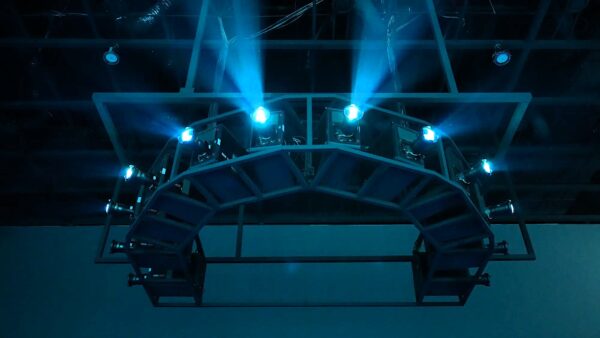
At InfoComm 2025, several companies, including Panasonic, Barco, and Digital Projection, introduced new commercial-grade projectors that featured robust laser-based illumination, delivering tens of thousands of lumens while providing simplified maintenance, compact designs, and enhanced 4K resolution, thanks to new DLP parts from Texas Instruments.
Panasonic
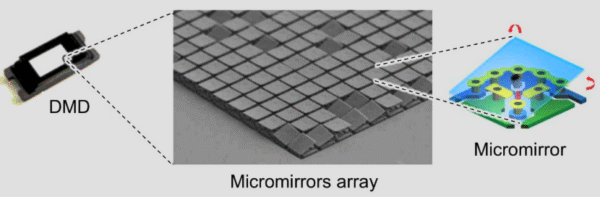
The Panasonic booth at InfoComm 2025 showcased the company’s latest large-venue projector, designated as the PT-RQ45K. This 3-chip DLP projector claims to deliver up to 40,000 lumens of light output at an effective resolution of 3,840 x 2,400 pixels (16:10 aspect ratio), utilizing a “Quad Pixel Drive” system, where each micromirror on the DLP chip drives four pixels. Its laser-phosphor light engine features two blue and one red laser module for expanded color gamut coverage and up to 20,000 hours of usage until half-brightness, longer if run in eco or quiet modes. This networkable projector offers flexible installation options, including 360-degree mounting capabilities and ruggedized (conformally coated) circuit boards that help resist corrosion from fumes and salt, making it suitable for outdoor use or in otherwise challenging projector environments. The PT-RQ45K is also compatible with a wide range of Panasonic zoom, fixed-focus, and fisheye lenses, as well as software for multi-projector monitoring and control.

Barco
Barco has long been at the forefront of digital projector development, and the company’s InfoComm announcements included a 4K upgrade for its QDX line of bright and reliable laser-phosphor projectors, dubbed the QDX-4K45. The new QDX is a 3-chip DLP (0.96″ DMD x3) design also sporting a pixel engine that produces 3,840 x 2,400 resolution – likely based upon a DLP part with a native 1,920 x 1,200 resolution using a 4x pixel drive system similar to the aforementioned Panasonic projector. The QDX-4K45’s 41,000-lumen light engine also features blue and red laser arrays coupled with an inorganic phosphor wheel, which claims up to 20,000 hours of operation at 100% power (until half-brightness).
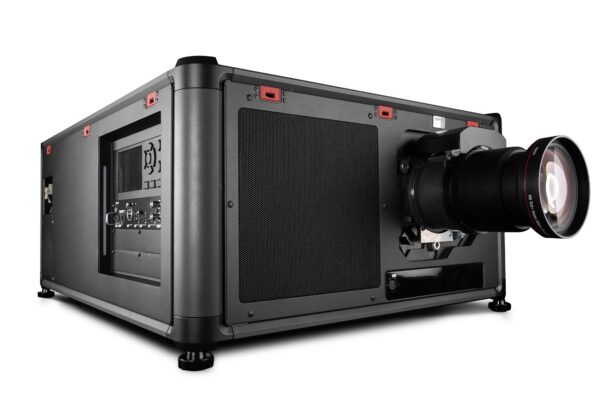
Also on display at the Barco booth was a unique accessory available for the company’s QDX series of projectors. Roughly the size of a large PC case, Barco’s external liquid-to-liquid cooler can be placed up to 24 meters away from an operating projector, capturing and exhausting 60-65% of the generated heat. The external cooler enables more QDX-series projectors to operate closer together, or it can allow for a modest reduction in noise levels.

Driving a Video Wall
Matrox graphics cards were among the earliest options for adding 3D-accelerated graphics to PC hardware, and the company’s unwavering support for 2D multi-display systems remains highly prized for its seamless implementation. Introduced at InfoComm 2025 was the company’s upcoming LUMA Pro A380 Octal graphics card, designed for multi-display video walls and digital signage applications.

LUMA Pro A380 Octal – Image credit: MatroxThe A380 Octal features a single-slot board design that incorporates two Intel Arc A380E GPUs. The Octal portion of the card’s name refers to its eight mini DisplayPort 2.0 connectors, each certified for UHBR10 performance, which effectively delivers up to 40 Gbps of video bandwidth. This configuration enables a single LUMA Pro A380 Octal card to drive up to eight synchronized 4K or 5K displays or up to four 8K displays.

Designed for use with Matrox’s Windows-based PowerDesk multi-display management software and Mura Developer Tools, up to two Pro A380 cards can be frame-locked to each other, enabling up to 16 displays to seamlessly display a variety of content, including copy-protected materials, via its support for HDCP 2.3.
Direct-view LED
If you’re anything like me, bright, colorful, and well-contrasted imagery stops you in your tracks. Of all the digital signage technologies in use today, none captivate me more than direct-view LED (DVLED). DVLED displays deliver dazzling brightness, color purity, and robust longevity. DVLED signage companies, including Daktronics, Fabulux, and AWALL, showcased new commercial products for indoor and outdoor use on the InfoComm 2025 show floor. I was also pleased to see a few DVLED options aimed at premium residential applications, which, while still relatively expensive, are a fraction of the price of similar offerings from a couple of years ago.

AWALL
The micro LED specialists at AWALL earned a Best of Show award for their 162″ DVLED display that offers native 4K resolution (3,840 x 2,160) pixels with a 16:9 aspect ratio and a pixel pitch of 0.9mm. The display’s die-cast aluminum cabinetry comprises a 6×6 array, with each cabinet composed of eight square-shaped, magnetically attached panels (each panel containing 28,800 LEDs).
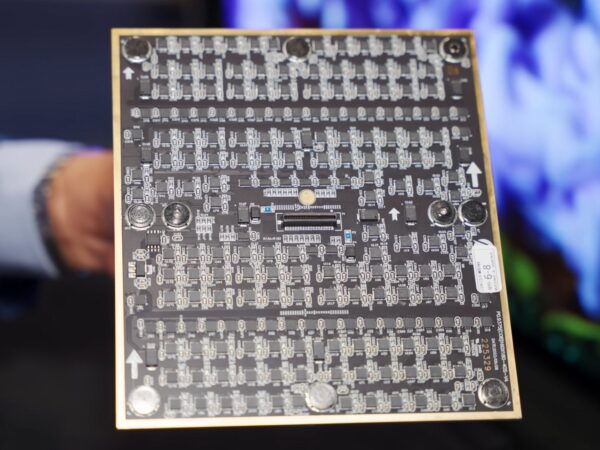
The assembled display offers a 3,840 Hz refresh rate, 1,200 nits of light output, and greater than 90% coverage of the BT.2020 color gamut featured in HDR content. Considering premium OLED TVs like the new LG G5 television, which achieve approximately 78% coverage of the BT.2020 gamut, the AWALL display showcases the color purity made possible with direct-view LED technology.

Available for an introductory price of $56,900, AWALL’s 162″ 4K display is one-quarter the cost of Samsung’s 146″ 4K The Wall All-in-One. However, potential owners of the 162″ AWALL display will have to add an external video processor, like those offered by NovaStar, to provide video input and screen configuration options. The “all-in-one” product naming in Samsung’s DVLED offering integrates the input and video processing hardware. AWALL has plans to offer even more affordable 75″ and 81″ pre-assembled models, albeit with sub-4K pixel resolution, that feature integrated video processors.
Robust Pixels
The display technologies featured at InfoComm 2025 highlighted flexible scaling for commercial applications. Hardware manufacturers were also eager to highlight an evolution of improvements aimed at lowering the cost of ownership by simplifying maintenance, easing transportation and setup, and making them generally more affordable. The compelling pixel technologies on display at InfoComm are helping businesses and more artistic endeavors, large and small, find new ways to capture our attention with increasingly detailed imagery.

Robert is a technologist with over 20 years of experience testing and evaluating consumer electronics devices, primarily focusing on commercial and home theater equipment.
Robert's expertise as an audio-visual professional derives from testing and reviewing hundreds of related products, managing a successful AV test lab, and maintaining continuous education and certifications through organizations such as CEDIA, the Imaging Science Foundation (ISF), and THX.
More recently, Robert has specialized in analyzing audio and video display systems, offering comprehensive feedback, and implementing corrective measures per industry standards. He aims to deliver an experience that reflects the artists' intent and provides coworkers and the public with clear, insightful product information.
- Robert Heronhttps://devsite.avnation.tv/author/robert-heron/

- Robert Heronhttps://devsite.avnation.tv/author/robert-heron/

- Robert Heronhttps://devsite.avnation.tv/author/robert-heron/

- Robert Heronhttps://devsite.avnation.tv/author/robert-heron/